
prosthetic leg
Home/Prosthetic Leg

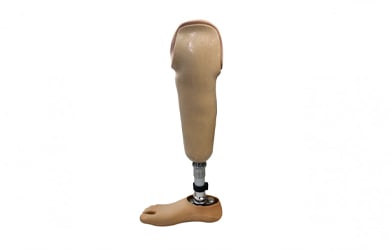
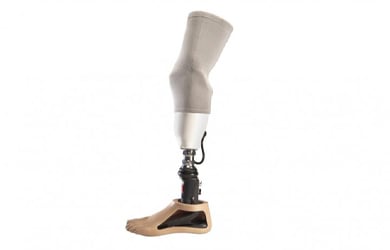
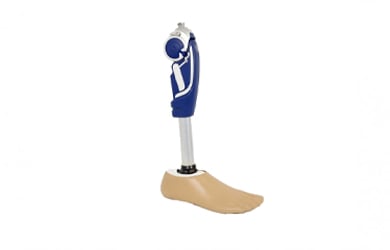
Prosthetic Leg

For individuals who have experienced lower-limb loss due to accidents, diabetes, vascular disease or congenital conditions, custom-made prosthetic legs restore walking, balance and independent living.

Prosthetic legs fall into two main categories: below-knee prosthesis and above-knee prosthesis. The right type is determined by a specialist based on the anatomical level of amputation. Every prosthesis is custom-made. Activity level, body structure and daily life goals directly shape the system that is built for you.
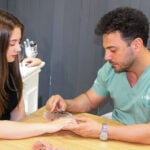
Patient walking with a custom prosthetic leg
2010 Years of expertise since

Amputation Level — Knee Preserved

Below Knee Prosthesis
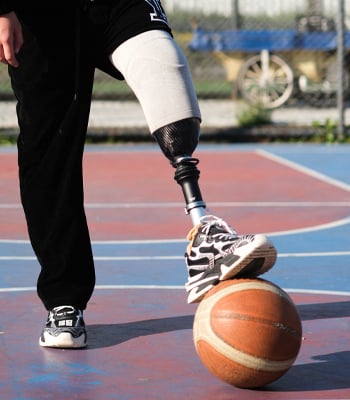
Knee joint preserved
Patient using a below knee prosthesis
Applied when amputation occurs below the knee joint. Because the knee remains anatomically intact, the muscles and the joint continue to be used actively.
Natural knee movement is preserved — shorter adaptation period and a more natural gait

Below knee prosthesis types

Pin-lock below knee prosthesis
Pin-Lock

Pin-Lock Below Knee Prosthesis

Secured to the socket through a pin or lock mechanism on the liner. Reliable suspension and easy on-and-off make it the most widely chosen system.
  • Pin or shuttle-lock mechanism
  • Reliable, stable suspension
  • Easy donning and doffing
  • Suitable for a wide activity range

Amputation Level — Artificial Knee Included

Above Knee Prosthesis
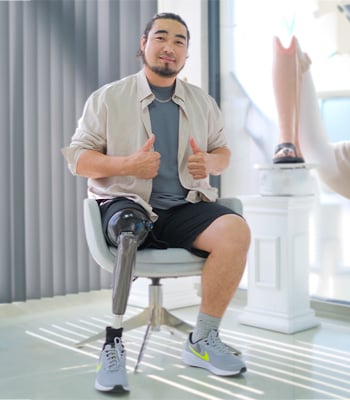
Artificial knee joint included
Above knee prosthesis general view
Applied when amputation occurs above the knee joint. An artificial knee joint is integrated into the system; the gait cycle is reconstructed through this mechanism.
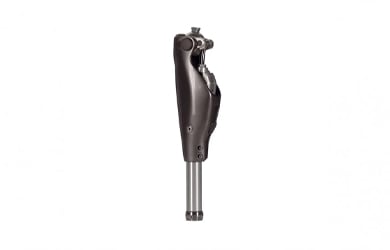
Artificial knee can be mechanical or microprocessor-controlled — selected based on activity level

Above knee prosthesis types

Mechanical above knee prosthesis
Mechanical

Mechanical Above Knee Prosthesis

Operates with hydraulic or pneumatic-controlled artificial knee joints. Contains no electronic components; its durable build and long lifespan make it suitable for low-to-moderate activity users.
  • Hydraulic or pneumatic knee joint
  • No electronic components
  • Durable, long service life
  • Low to moderate activity level

System Structure

Prosthetic Leg Components

All prosthetic leg systems share the same core components. The knee joint is added only to above-knee prosthetic systems.

Socket

The main component custom-made to the user’s anatomy where the residual limb is fitted. Foundation of comfort and stability.

Both levels

Liner

A protective inner sleeve made of silicone or gel placed between the residual limb and the socket.

Both levels

Pylon / Tube

The structural connecting element between the socket and the prosthetic foot. Made of titanium or carbon fiber.

Both levels

Prosthetic Foot

The lowest component that contacts the ground and directly affects walking dynamics.

Both levels

Knee Joint

The mechanical or microprocessor artificial joint that provides flexion and extension movement.

Above knee only

Walking Dynamics

Carbon Fiber Prosthetic Foot Types

The prosthetic foot is the component that contacts the ground and directly shapes walking dynamics. It’s part of every below-knee and above-knee system. The right choice is made by a specialist based on activity level and personal goals.

01

SACH Foot

Solid, easy-to-maintain and economical model. Preferred by low-activity users and as a starter prosthetic foot. Entry / Economical

02

Dynamic-Response Foot

Carbon fiber model that stores energy during walking and releases it on push-off. Suitable for active users. Moderate–High Activity

03

Hydraulic Ankle Foot

Automatically adapts to different ground conditions and slope angles. Improves daily-life comfort on uneven terrain. Terrain Adaptive

Pricing Information

Prosthetic Leg Cost

Prosthetic leg pricing is determined individually. Even at the same amputation level, two users can have significantly different needs and therefore different costs.

Price range

€3,000  to  €70,000

The final price depends on the amputation level, component brand and technology, your activity level and your individual anatomy. A basic below-knee system with a SACH foot sits at the lower end, while a microprocessor (bionic) above-knee prosthesis sits at the higher end.

Entry

Below-knee, basic foot

from €3,000

Mid-range

Vacuum, dynamic foot

€8,000 – €25,000

Premium

Microprocessor knee

up to €70,000

Factors that affect the price

Amputation level
Component brand
Technology level
Activity level
Personal anatomy
Foot type selected

Production Process

How is a Prosthetic Leg Made?

Building a custom prosthetic leg is a precise process. From measurement to delivery, every step is carried out according to the individual’s anatomy and goals.

1

Evaluation & Measurement

Our specialists examine the residual limb, amputation level and anatomical structure, then take detailed individual measurements for the socket.
2

Socket Casting & Test Fitting

A custom socket is built using either a plaster cast or a digital 3D scan of the residual limb. A test prosthesis is fitted and adjusted with the patient’s feedback.
3

Component Selection & Alignment

The right knee joint, pylon and prosthetic foot are selected based on activity level. Static and dynamic alignment is tuned for a natural gait.
4

Delivery & Gait Training

The final prosthesis is delivered, walking training is provided and follow-up adjustments are scheduled to ensure long-term comfort.


The Basics

What Is a Prosthetic Leg and Who Is It For?

A prosthetic leg is a custom-made artificial limb that helps people who have lost part of a leg to stand, balance and walk. It cannot fully replace the natural leg, but a well-fitted system can restore much of your mobility and independence.

Leg loss can result from accidents, diabetes, vascular disease, infection, tumors or congenital conditions. The first factor that decides which system is suitable is the level of amputation, because it determines whether your own knee is preserved.

LevelWhat it meansHow the prosthesis differs
Foot and anklePart of the foot is missing; ankle and knee are preserved.Partial-foot solutions are used; silicone or carbon-supported options are assessed by level.
Below-kneeThe knee is preserved, with loss below it.The prosthesis has a socket, liner, pylon and foot; your own knee movement is kept.
Knee disarticulation and above-kneeThe knee joint is lost.An artificial knee is added and walking is re-created through it.
Hip levelThe upper leg or hip region is also affected.The socket sits on the trunk and joins hip, knee and foot components; the solution varies greatly and needs an in-person assessment.

For a detailed comparison, read: Below-knee vs above-knee prostheses.


Comparison

Prosthetic Knee Types: Mechanical, Pneumatic, Hydraulic and Microprocessor

For above-knee and knee-disarticulation prostheses, the type of artificial knee determines how walking feels, how well it adapts to speed changes and how much maintenance it needs. The table is a general comparison; individual models differ.

Scroll the table sideways to see all columns.

MechanicalPneumaticHydraulicMicroprocessor
How it worksFriction and locking mechanisms; no electronicsAir pressure controls the swing phaseFluid resistance controls the swing and/or stance phaseSensors and a processor adjust resistance while you walk
Adapting to walking speedLimitedModerateBetter adaptation to speed changesReal-time adaptation, depending on the model
Points to considerSimpler gait; may limit more demanding activityRegular maintenance neededRegular maintenance neededBattery and charging, electronic servicing, moisture, training
Note: A more advanced knee is not always the better choice. The right knee depends on your activity level, strength, balance, age and daily routine. For a deeper comparison see Microprocessor knee vs hydraulic knee.

Choosing Guide

Which Prosthetic Leg Is Right for You?

The right system is not chosen on a single criterion. Your amputation level, the condition of the residual limb, strength, balance, daily routine and goals are assessed together. Doctors and prosthetists also use an activity level scale (K0 to K4) to match the knee and foot to you.

Activity levelGeneral description
K1Limited walking at a steady pace, usually indoors.
K2Limited community walking; can cross low obstacles such as curbs, steps or uneven surfaces.
K3Walking at variable speed; can cross most obstacles and may be active at work or in exercise.
K4High-impact, high-energy activity beyond basic walking, such as sport; active adults and children.
  • If this is your first prosthesis: safety, comfort and correct alignment come first. Below the knee, the liner and suspension system matter most; above the knee, the knee type matters most.
  • If you are very active or play sports: energy-storing carbon feet and, where appropriate, more advanced knees are considered.
  • If you walk shorter distances: simple, reliable and low-maintenance systems are often enough. More advanced does not always mean better.
  • If the volume of your residual limb changes often: suspension systems that adapt to volume changes, such as vacuum, can be discussed.
  • For children and teenagers: sockets and components are checked more often because of growth.

More guidance: How to choose your first prosthetic leg and Silicone liner selection for below-knee prostheses.


Care and Lifespan

Prosthetic Leg Care, Follow-Up and Lifespan

Regular care affects both comfort and how long the prosthesis lasts. The points below are general; follow the instructions you receive at delivery for your own prosthesis.

Residual limb skin

Check the skin every day. If you see redness, blisters, wounds or swelling, stop using the prosthesis and contact your prosthetic center or doctor.

Socket and liner

Clean the liner after use and let it dry. Check the inside of the socket and the suspension parts regularly, and replace a worn or torn liner.

Foot, pylon and knee

If you notice looseness, noise or a change in your walking, come for a check without waiting. Microprocessor knees need charging as instructed and should be kept away from moisture.

Follow-up and renewal

Weight change, swelling and muscle loss alter socket fit, and components wear over time. Periodic follow-up visits keep the fit and alignment correct, and parts are renewed when needed.

More on care: Prosthetic leg socket pain: causes and checks.


Common Questions

Prosthetic Leg: Frequently Asked Questions

What is a prosthetic leg and how does it work?
A prosthetic leg is a custom-made artificial limb that helps a person stand and walk after the loss of part of the leg. It is built from a socket that holds the residual limb, a liner between the limb and socket, a pylon (tube), a prosthetic foot and, for above-knee levels, an artificial knee joint. The socket is made to the shape of your limb, so it has the biggest effect on comfort and control.
What is the difference between a below-knee and an above-knee prosthesis?
With a below-knee (transtibial) amputation your own knee is preserved, so the prosthesis consists of a socket, liner, pylon and foot. With a knee-disarticulation or above-knee (transfemoral) amputation the knee is lost, so an artificial knee joint is added and walking has to be re-created through that joint. Above-knee systems are more complex and the learning period is usually longer.
What is a microprocessor knee and is it right for everyone?
A microprocessor knee uses sensors and a small processor to adjust the resistance of the knee while you walk. It is not suitable for everyone: the choice depends on activity level, age, general health, balance and daily use. Many people walk very well with mechanical or hydraulic knees, so the right knee is decided together after an assessment.
How long does it take to make a prosthetic leg?
The time depends on the amputation level, the type of system, the condition of the residual limb and the number of test fittings needed. We give you an estimated timeline at the measurement visit. You can also read our guide on how long a prosthetic leg takes in Turkey.
When can a prosthesis be fitted after amputation?
The timing is decided by your surgeon and prosthetic team according to wound healing, swelling and the shape of the residual limb. Because the limb changes shape in the first months, some people start with a temporary prosthesis and receive the definitive prosthesis once the limb has settled.
How long does it take to learn to walk with a prosthetic leg?
It varies a lot between people and depends on the amputation level, age, muscle strength, balance and general health. Walking training covers putting the prosthesis on and off, shifting weight, balance, and walking on stairs and slopes. Above-knee users usually need more time. We do not promise a fixed period.
Can I shower or swim with a prosthetic leg?
Most prosthetic legs, and especially microprocessor knees, are not waterproof, and moisture can damage mechanical and electronic parts. Some feet and components are made for water use. Always check the protection rating of your model and follow the instructions given at delivery. Ask us about water-friendly options if showering or swimming matters to you.
Can a prosthetic leg cause pain or skin problems?
A well-fitting socket should not cause constant pain. Pressure points, redness, blisters or wounds mean the fit needs adjusting, so stop using the prosthesis and contact your prosthetic center or doctor. Changes in weight and swelling can alter the fit. Read more in our guide to socket pain causes. Pain felt in the missing limb is called phantom limb pain and is common; talk to your doctor about it.
Can I climb stairs, run or play sports with a prosthetic leg?
Many people walk on stairs and slopes and return to daily activities. What you can do depends on your level of amputation, muscle strength and the knee and foot system. Running and high-impact sports usually need a different foot, so tell us your goals and we will plan the system accordingly.
What are activity levels (K0 to K4)?
Activity level is a classification used by doctors and prosthetists to describe a person's walking ability. K1 is limited walking at a steady pace, usually indoors; K2 is limited community walking with low obstacles such as curbs and stairs; K3 is walking at variable speed over most obstacles; K4 covers high-impact and high-energy activity such as sport. It helps match the knee and foot to your needs.
Do I need to come to Turkey for my prosthetic leg?
That depends on your situation. Our team makes scheduled visits to several countries and also receives patients in Istanbul. The International Service section on this page explains how the process works. Contact us with your country and amputation level and we will tell you the practical options.
Does insurance cover a prosthetic leg?
Turkey's social security institution (SGK) reimburses prosthetic legs for people insured within Turkey's general health insurance system. International patients who are not insured in Turkey usually pay privately. Coverage from your own insurer varies by country and policy, so check with your insurer before treatment. If you want us to review your situation, send us the details.
How long does a prosthetic leg last?
It depends on how much you use it, your weight and activity, changes in your residual limb and how well it is maintained. Sockets and liners may need adjustment or renewal earlier than the rest of the system, and components such as feet and knees wear over time. Regular follow-up visits help catch problems early.
Can children use prosthetic legs?
Yes. Children grow quickly, so the socket and components are checked and replaced more often. The system is planned according to the child's age, development and activity and the family's expectations.
How much does a prosthetic leg cost?
The cost depends on the amputation level, the type of system (below-knee or above-knee, mechanical or microprocessor knee), the foot, the components and your activity level. A clear price can only be given after an assessment. See our guide on why prosthetic leg cost varies and our cost guide for Turkey.

This page is for general information and is not medical advice or a treatment recommendation. For cost details see Prosthetic leg cost in Turkey 2026 and Why prosthetic leg cost varies. For timing see How long does it take to get a prosthetic leg in Turkey? Last updated: 27 October 2026.

International Service

Luxmed in 40 Countries

You don’t need to travel across continents to receive your custom prosthetic leg. With our mobile service network covering 40 countries, our specialists come directly to you.

You Don’t Have to Come to Turkey

Our specialists travel to your country on scheduled dates and conduct a free in-person evaluation and measurement.

Small Deposit Only

To reserve your appointment, only a small deposit is required upfront. The remaining balance is settled when your prosthesis is delivered.

Delivery Time Guarantee

Once measurements are taken, your finished prosthesis is delivered to your country within 2 to 8 weeks on the next visit.


    Not sure which prosthesis is right for you?

    Our specialists provide a free evaluation — in Istanbul or in your country.