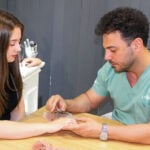

For individuals who have experienced lower-limb loss due to accidents, diabetes, vascular disease or congenital conditions, custom-made prosthetic legs restore walking, balance and independent living.

Amputation Level — Knee Preserved
Below Knee Prosthesis
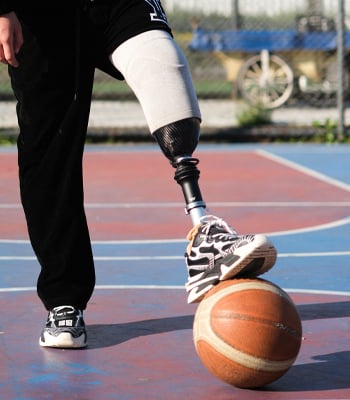
Below knee prosthesis types
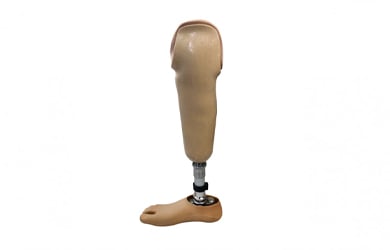
Pin-Lock Below Knee Prosthesis
Secured to the socket through a pin or lock mechanism on the liner. Reliable suspension and easy on-and-off make it the most widely chosen system.- Pin or shuttle-lock mechanism
- Reliable, stable suspension
- Easy donning and doffing
- Suitable for a wide activity range
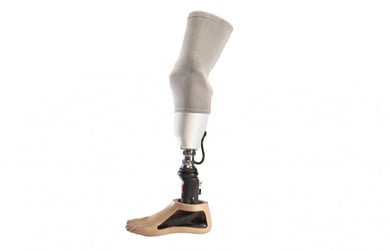
Vacuum-Suspension Below Knee Prosthesis
An advanced suspension system that holds the residual limb in place using negative pressure inside the socket. Protects residual-limb health and maximizes walking comfort for active users.- Strong suspension via negative pressure
- Minimizes residual limb volume change
- Comfort over long walking distances
- Ideal for active and high-activity users
Amputation Level — Artificial Knee Included
Above Knee Prosthesis
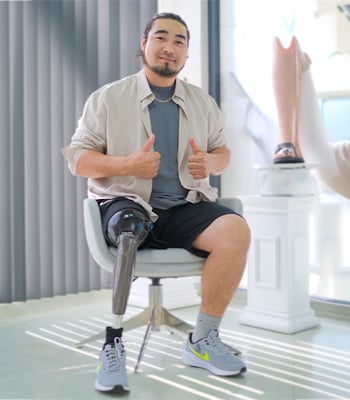
Above knee prosthesis types
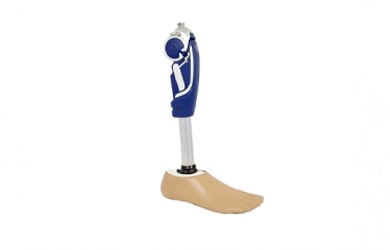
Mechanical Above Knee Prosthesis
Operates with hydraulic or pneumatic-controlled artificial knee joints. Contains no electronic components; its durable build and long lifespan make it suitable for low-to-moderate activity users.- Hydraulic or pneumatic knee joint
- No electronic components
- Durable, long service life
- Low to moderate activity level
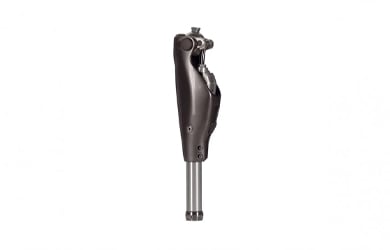
Bionic Above Knee Prosthesis
Microprocessor-controlled knee joint that adapts in real time using sensor data. Automatically adjusts to stairs, slopes and changes in walking speed for the highest level of comfort and safety.- Real-time sensor-based adjustment
- Automatic stair and slope adaptation
- Reduces fall risk
- Ideal for active users
System Structure
Prosthetic Leg Components
All prosthetic leg systems share the same core components. The knee joint is added only to above-knee prosthetic systems.
Socket
The main component custom-made to the user’s anatomy where the residual limb is fitted. Foundation of comfort and stability.
Both levelsLiner
A protective inner sleeve made of silicone or gel placed between the residual limb and the socket.
Both levelsPylon / Tube
The structural connecting element between the socket and the prosthetic foot. Made of titanium or carbon fiber.
Both levelsProsthetic Foot
The lowest component that contacts the ground and directly affects walking dynamics.
Both levelsKnee Joint
The mechanical or microprocessor artificial joint that provides flexion and extension movement.
Above knee onlyWalking Dynamics
Carbon Fiber Prosthetic Foot Types
The prosthetic foot is the component that contacts the ground and directly shapes walking dynamics. It’s part of every below-knee and above-knee system. The right choice is made by a specialist based on activity level and personal goals.
01
SACH Foot
Solid, easy-to-maintain and economical model. Preferred by low-activity users and as a starter prosthetic foot. Entry / Economical02
Dynamic-Response Foot
Carbon fiber model that stores energy during walking and releases it on push-off. Suitable for active users. Moderate–High Activity03
Hydraulic Ankle Foot
Automatically adapts to different ground conditions and slope angles. Improves daily-life comfort on uneven terrain. Terrain Adaptive04
Microprocessor Foot
Analyzes sensor data per step and makes real-time adjustments. Highest technology and comfort level available. Advanced TechnologyPricing Information
Prosthetic Leg Cost
Prosthetic leg pricing is determined individually. Even at the same amputation level, two users can have significantly different needs and therefore different costs.
€3,000 to €70,000
The final price depends on the amputation level, component brand and technology, your activity level and your individual anatomy. A basic below-knee system with a SACH foot sits at the lower end, while a microprocessor (bionic) above-knee prosthesis sits at the higher end.
Entry
Below-knee, basic foot
from €3,000
Mid-range
Vacuum, dynamic foot
€8,000 – €25,000
Premium
Microprocessor knee
up to €70,000
Factors that affect the price
Production Process
How is a Prosthetic Leg Made?
Building a custom prosthetic leg is a precise process. From measurement to delivery, every step is carried out according to the individual’s anatomy and goals.
Bu gönderiyi Instagram’da gör
Evaluation & Measurement
Our specialists examine the residual limb, amputation level and anatomical structure, then take detailed individual measurements for the socket.Socket Casting & Test Fitting
A custom socket is built using either a plaster cast or a digital 3D scan of the residual limb. A test prosthesis is fitted and adjusted with the patient’s feedback.Component Selection & Alignment
The right knee joint, pylon and prosthetic foot are selected based on activity level. Static and dynamic alignment is tuned for a natural gait.Delivery & Gait Training
The final prosthesis is delivered, walking training is provided and follow-up adjustments are scheduled to ensure long-term comfort.International Service
Luxmed in 40 Countries
You don’t need to travel across continents to receive your custom prosthetic leg. With our mobile service network covering 40 countries, our specialists come directly to you.