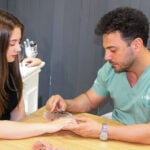
A silicone prosthesis is a custom-made medical device designed to provide both aesthetic restoration
and functional support for individuals who have experienced limb or tissue loss. Medical-grade silicone is the
preferred material in this field thanks to its biocompatibility, flexibility and durability.
Every silicone prosthesis is individually designed around the patient’s anatomy and personal
needs. Skin tone, surface texture, vein patterns and skin wrinkles are all crafted to match the user’s body,
creating a lifelike, discreet appearance.

Licensed center since
By Body Region
Types of Silicone Prosthesis
Silicone prostheses are designed differently based on the body region where the loss occurred. Each
type is custom-made to the patient’s anatomy and daily-life needs, using medical-grade silicone.
![]()
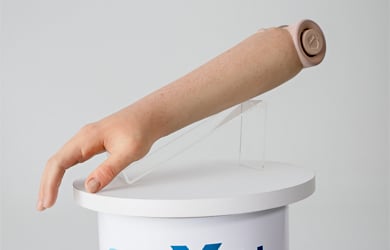
Arm
Silicone Arm Prosthesis
Applied to both below-elbow (transradial) and above-elbow (transhumeral) amputations. Skin tone, surface
texture and vein details are individually crafted.
- Below-elbow / above-elbow applications
- Custom skin tone and vein patterns
- Realistic surface texture & wrinkles
![]()
Hand
Silicone Hand Prosthesis
Used for partial or full hand amputations. Beyond aesthetics, it can support basic gripping movements and
acts as counter-support for the sound hand.
- Accurate finger proportions & nail structure
- Detailed joint lines & knuckle creases
- Supports basic grasping movements
![]()
Foot
Silicone Foot Prosthesis
Used for forefoot or partial foot loss (transmetatarsal amputations). Helps restore balance and support
during walking while maintaining a natural appearance.
- Suitable for forefoot & partial foot loss
- Supports balance while walking
- For traumatic & congenital cases
![]()
Finger
Silicone Finger Prosthesis
Applied for single or multiple finger amputations. Finger length, nail bed and joint lines are referenced
from the sound hand for a symmetrical, lifelike result.
- Single or multi-digit replacement
- Realistic nail bed & joint lines
- Symmetrical with the sound hand
![]()
Ear
Prosthetic Ear (Silicone Ear Prosthesis)
Designed for patients who have lost ear tissue due to trauma, disease, microtia or other congenital
conditions. Mirrors the healthy ear’s shape, skin tone and surface detail.
- For microtia & traumatic ear loss
- Adhesive or implant-retained attachment
- Mirrors the contralateral ear
![]()
Nose
Prosthetic Nose (Nasal Prosthesis)
Restores contour and appearance for patients who have experienced partial or total nose loss due to trauma,
cancer (post-rhinectomy) or congenital conditions.
- Custom-matched facial anatomy
- Individual skin-tone matching
- Adhesive or implant-retained fixation
International Service
Our Specialists Can Come to You
You don’t need to travel across continents to receive your custom silicone prosthesis. With our
mobile service network covering several countries, our specialists come directly to you.
You Don’t Have to Come to Turkey
Our specialists travel to your country on scheduled dates and conduct a
free in-person evaluation and measurement.
Easy Payment
We don’t ask for the full payment upfront. A small deposit reserves your
appointment; the balance is settled on delivery.
Delivery Time
We guarantee delivery within 2 to 8 weeks after the initial measurement
visit in your country.
Production Process
How is a Silicone Prosthesis Made?
Producing a custom silicone prosthesis is a precise, multi-stage process. From measurement to
delivery, every step is carried out according to the individual’s anatomy and goals.
1
Evaluation & Measurement
Our specialists examine the
amputation site and anatomical structure, then take detailed individual measurements for the prosthesis.
2
Impression & Test Fitting
An impression is taken using
the sound limb or contralateral reference area. A test prosthesis is fitted on the patient and approved
before final production.
3
Color Matching & Detailing
Skin tone, vein patterns,
freckles, fingerprints and skin texture are crafted in detail under natural daylight to perfectly match
your body.
4
Fitting & Care Training
The final prosthesis is
fitted, and you receive personalized training on daily wear, attachment and proper cleaning to ensure
long-term use.
Custom silicone prostheses are typically completed within 2 to 6 weeks after the measurement
stage.
Pricing Information
Silicone Prosthesis Cost
Silicone prosthesis pricing is determined individually. The type of prosthesis, complexity of detail
and your individual anatomy directly shape the final cost.
€1,500 to €15,000
Final pricing depends on the prosthesis type, level of detail, attachment method (adhesive,
suction or implant-retained) and individual anatomy. A single finger prosthesis sits at the entry level, while a
full silicone arm or facial prosthesis (ear, nose) is priced higher.
Entry
Single finger prosthesis
from €1,500
Mid-range
Partial hand / foot / ear
€3,000 – €7,000
Premium
Full silicone arm / nose
up to €15,000
Factors that affect the price
The Basics
What Is a Silicone Prosthesis and Who Is It For?
A silicone prosthesis is a custom-made, medical-grade silicone prosthesis that completes the appearance of a missing finger, hand, arm, foot, ear or nose with skin-like color and texture. Most are passive; their aim is appearance and a sense of wholeness, and in suitable designs they can also support basic gripping or balance.
It is considered for people who have lost tissue through accident, workplace injury, illness, tumor surgery or congenital causes. The right design depends on the area, the remaining tissue and your daily needs.
| Area | What it is used for | Points to consider |
|---|---|---|
| Finger | Completes the look and proportions of one or more missing fingers. | Nail structure and joint lines are prepared to match the other fingers; the movement of the remaining tissue affects the design. |
| Partial hand | Completes the look of a partly missing hand and may support basic gripping. | The level of loss and remaining joint movement are decisive. |
| Arm (wrist, below-elbow, above-elbow) | Gives a cosmetic (passive) arm and hand appearance. | For active gripping, mechanical or myoelectric prostheses are assessed separately. |
| Toes and foot (single or several toes, forefoot, partial foot, Chopart, Boyd, Pirogoff) | Completes the look of missing toes or a partial foot and may support balance and push-off. | Shoe fit and walking needs are assessed; the big toe matters most for push-off. |
| Ear and nose | Completes the look after tissue loss in the face. | Attachment (adhesive, magnet or implant-supported) is chosen individually. |
For finger loss, read: Guide to choosing a prosthesis after finger amputation. For toe and partial-foot loss, read: Prosthetic toes: custom silicone toe prosthesis explained.
Comparison
Silicone Prosthesis, Prosthetic Glove and Functional Prosthesis: What Are the Differences?
For hand and finger loss there are several options. Which one suits you depends on whether appearance or function is the priority and on the level of loss.
Scroll the table sideways to see all columns.
| Custom silicone prosthesis | Prosthetic glove | Functional prosthesis (mechanical, myoelectric) | |
|---|---|---|---|
| Purpose | Natural look and wholeness; basic support in suitable designs | Completes the look of the hand and fingers | Supports functions such as gripping and holding |
| How it is made | Custom mold, color matching and detailing | Applied as a glove-type product | Socket, frame and hand component made to your measurements |
| Movement | Mostly passive; may follow the remaining tissue | Passive | Controlled by cable or by muscle signals |
Attachment Methods
How Is a Silicone Prosthesis Attached?
The attachment method is chosen according to the area, the condition of your skin and residual limb, your daily habits and your expectations. These are general options; the suitable one is decided together at the examination.
Close fit and friction
Finger, hand and foot prostheses mostly stay in place through a close fit to the residual limb and friction. No extra adhesive may be needed, which is why impression and mold accuracy matter.
Skin-safe adhesive
Some prostheses use medical skin adhesives. If your skin is sensitive, alternatives are discussed.
Magnet-supported
For facial prostheses, magnet-supported fixation can be considered where suitable.
Implant-supported
For ear and nose prostheses, implant-supported fixation may be considered after a doctor's assessment. This requires a surgical procedure.
Timing and function: When can a silicone finger prosthesis be made?
Choosing Guide
Which Silicone Prosthesis Is Right for You?
The right solution is not chosen on a single criterion. The level of loss, the movement of the remaining tissue, your skin, your daily work and your expectations are assessed together.
- If appearance is your priority: a custom silicone prosthesis stands out with its skin-tone and texture matching.
- If you need strong gripping or to carry loads: a silicone prosthesis alone may not be enough; functional prostheses or a combination are considered.
- If you use your hands heavily at work: durability and ease of care under your working conditions are discussed together.
- If you have sensitive or allergic skin: the attachment method and material are planned accordingly.
- For children and teenagers: fit is checked and renewed more often because of growth.
The final decision is made together after the examination and measurement.
Care and Lifespan
Silicone Prosthesis Care and Lifespan
Regular care affects both appearance and how long the prosthesis lasts. The points below are general; follow the instructions you receive at delivery for your own prosthesis.
Cleaning
Clean gently with lukewarm water and mild soap, rinse well and dry. Do not use abrasive products or solvents.
Protection
Keep away from sharp objects, high heat and long direct sun. These can affect the surface and color of the silicone.
Skin check
Check the skin under the prosthesis every day. If you see redness, irritation, sores or swelling, stop using the prosthesis and contact your prosthetic center or doctor.
Renewal
Surface wear, color change and changes in your skin or residual limb may call for adjustment or replacement. Actual lifespan depends on use and care.
Common Questions
Silicone Prosthesis: Frequently Asked Questions
What is a silicone prosthesis?
Who is a silicone prosthesis suitable for?
Does a silicone prosthesis move?
How long does it take to make a silicone prosthesis?
Will the color match my skin exactly?
How is a silicone prosthesis attached?
Can I shower or swim with a silicone prosthesis?
How do I clean and care for a silicone prosthesis?
How long does a silicone prosthesis last?
What is the difference between a silicone prosthesis and a prosthetic glove?
Can a silicone prosthesis replace a functional prosthesis?
Does insurance cover a silicone prosthesis?
Can children have silicone prostheses?
Can I get a silicone prosthesis if I live abroad?
How much does a silicone prosthesis cost?
This page is for general information and is not medical advice or a treatment recommendation. For cost details see Silicone finger prosthesis cost in Turkey 2026. Last updated: 27 October 2026.
Not sure which prosthesis
is right for you?
Our specialists provide a free evaluation — in Istanbul or in your country.
What our patients say on Google
Google Maps rating: 4.7 / 5 from 221 reviews (October 2026).
“While some clinics told us it would not be possible to do it with 5 fingers, they made it happen.”
— Marigona O., family member of a patient · Google review
Can’t travel to Istanbul?
Our specialists travel to your city or country for assessment, measurement, fitting and rehabilitation, even for a single patient.
Prosthetic services in your country
Enes Altun
Prosthetic & Orthotic Technician · Co-founder and Responsible Director, Luxmed Protez
Working in orthotics and prosthetics since 2010. The information on this page has been reviewed by him. Certificates · About us